
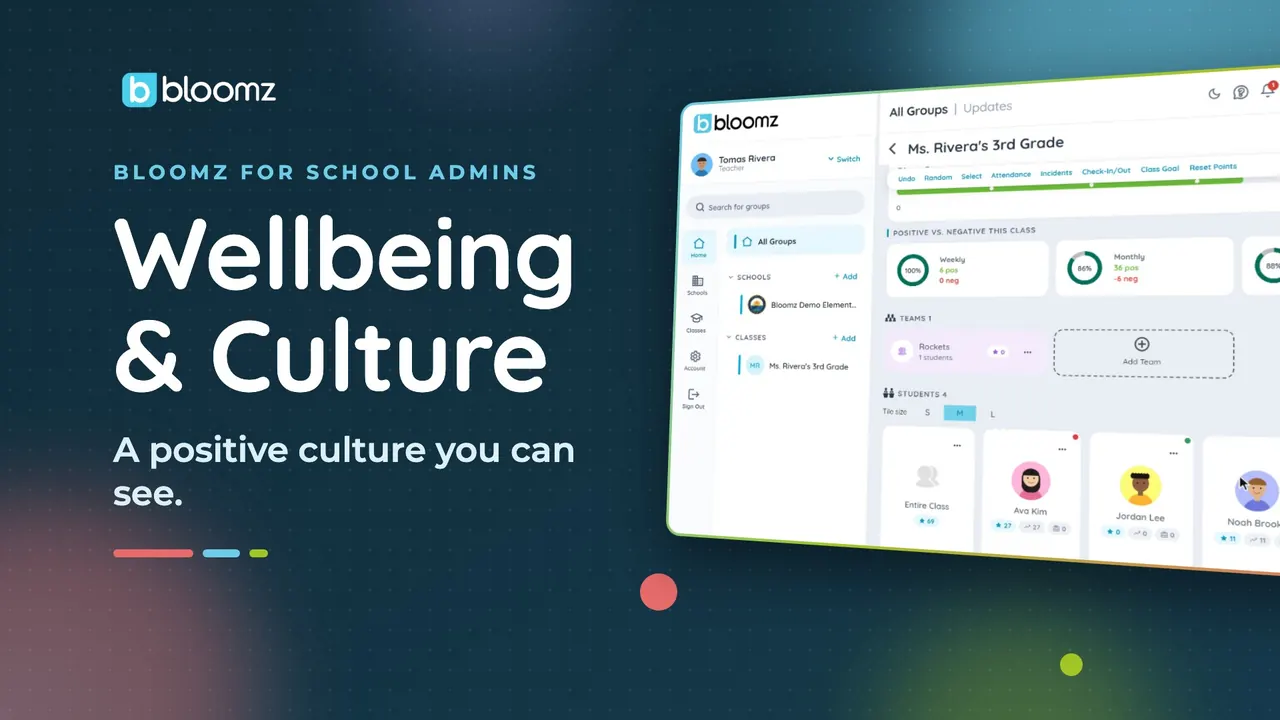
The 360° student view, attendance, behavior, and SEL on one timeline
Most schools watch attendance in the SIS, behavior in a separate tool, and SEL nowhere, so no one sees the student whole until there's a crisis. Bloomz puts all three on one profile: today's attendance, this week's recognition, the Tier II pattern forming, every message home. The staff member who needs to act sees the whole picture, and acts while it still matters.
Chronic absenteeism, caught early, while you can still change it
Chronic absenteeism is a relationship problem before it's a data problem, and it's only fixable early. Attendance flows from your SIS into same-morning family notices, and every absence lands on the student's timeline next to behavior and engagement. Students nearing the chronic threshold surface to the counselor queue automatically, with full context, so outreach happens at absence five, not fifteen.

Same-day notices in every family's language. Tap a flagged student to send outreach and watch the queue clear. Try it.
Standardize school-wide, one behavior language for the whole building
Define your behavior interaction set once at the school or district level and it flows into every classroom. Build houses or teams that rally students toward shared goals, choose themes that work from elementary through secondary, and let teachers track interactions anywhere, the hallway, the cafeteria, the bus line, not just the classroom.
Tap a student, award a value, and the family sees the recognition in their language, instantly. Try it.
Flags: automate the follow-through on milestones and Tier II
Behavior flags turn your MTSS playbook into automated action: a student crossing 25 points this month triggers a recognition note home; a Tier II pattern notifies the right staff members; a referral threshold generates the administrator notification, consistently, every time, without relying on a teacher to remember to send an email.
Set the rules once; Bloomz watches every student and acts automatically, recognition home, or the right adult notified.
Positive culture & parent visibility, recognition that reaches home in every language
Positive culture compounds only when it's seen, by the student and the family. Every positive interaction can become a note home, a badge, or a whole-school celebration, in the family's language. Parents don't just hear about problems; they see their child's wins, attendance, and growth in one place. The student who shows responsibility in third period is celebrated at dinner that night, in Spanish, Vietnamese, or Arabic.
Positive recognition reaches families in their own language, celebrating the moment, not just reporting it.
Classroom Toolkit, and it writes to the same ledger
A timer, a noise meter, a random student picker and a group maker — the four things a teacher reaches for mid-lesson — built into the app that is already open. All four run on the device: the noise meter reads the microphone level on your device; audio is never uploaded. What makes it more than a widget drawer is where it hands off. Recognize a student the picker just chose and it posts through the same Interactions endpoint as every other recognition, so it lands on the same behavior record and reaches the family in their language. Save the groups you just made and they persist as real Interactions teams, ready next lesson. Reachable from the Interactions page itself, not buried in a menu.
Four tools that run entirely on the teacher's device — then hand off to the same Interactions ledger the rest of Bloomz uses. Pick a student, then Recognize them.
Reporting depth, the 360° view, district-wide
Analyze behavior across classes, staff, students, interaction types, and locations, over any window from a week to a school year. This is the reporting layer evaluation committees mention when choosing Bloomz over competitors. Export to CSV and take your data to any system your district uses.
Positive vs. corrective interactions over any window. Switch the range, toggle a series, board-ready in one click. Try it.
PBIS and student recognition: common questions
Bloomz includes school-wide PBIS in the same app families already use for school communication: behavior interaction sets defined once at the school or district level, points, houses and teams, milestone recognition, and positive notes home in the family's language.
Teachers record interactions anywhere in the building, such as the hallway, the cafeteria or the bus line, not only in the classroom. Schools set their own thresholds. For example, a student crossing 25 points in a month can trigger a recognition note home automatically.
Yes. Schools build houses or teams so students and staff work toward shared behavior goals across the building, with themes that suit elementary through secondary grades.
Yes. Awards and milestones are shared with families automatically, in their language, across 250+ languages. Parents see their child's wins alongside attendance in one place.
Yes. Behavior flags notify the relevant staff when a Tier II pattern emerges, and a referral threshold generates the administrator notification. The thresholds and escalation paths are the school's own.
No. Attendance, behavior, recognition and SEL check-ins sit on one student profile, in the same platform as family communication.
Connected across Bloomz
Also see: ClassDojo alternatives for schools and districts, digital hall pass.
20 minutes with Bloomz
answers more than 20 pages ever could.
Bring your hardest scenario, a multilingual community, a PBIS rollout, a vendor consolidation, and we'll walk through the actual product.